Wisdom Begins In Wonder
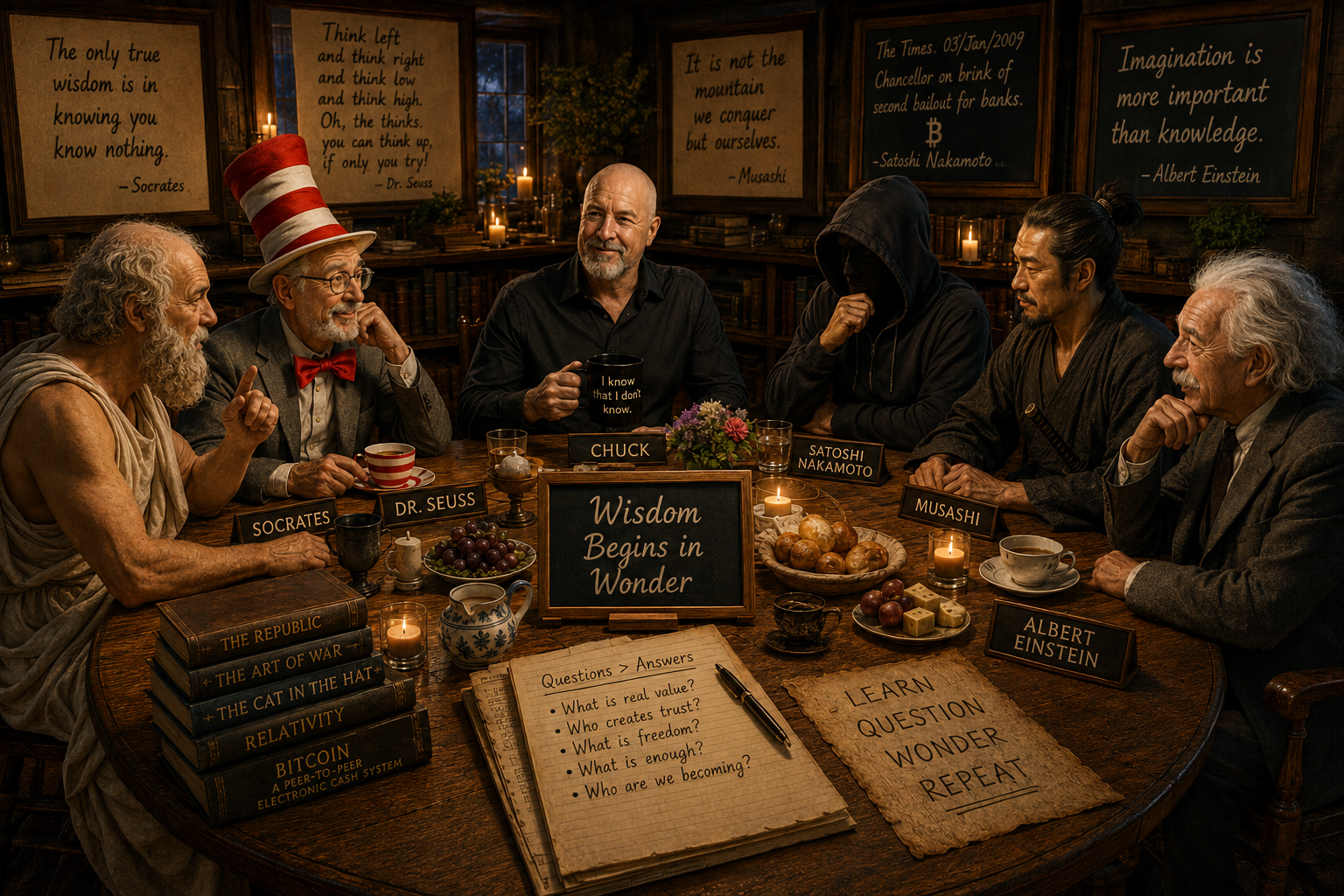
Dinner with Socrates, Dr. Seuss, Satoshi, Musashi & Albert
“The more I learn, the less certain I become.”
That isn’t discouraging.
It’s liberating.
As children, we believed adults knew everything. As young adults, we believed we knew almost enough. Somewhere in middle age, if we are fortunate, we begin to discover a remarkable truth:
The wisest people often ask the most questions.
Recently I caught myself laughing after saying, “I’m even less than Socrates…but at least I know that I don’t know.”
There is a strange freedom in admitting that.
Not because ignorance is something to celebrate, but because pretending to know has prevented more learning than ignorance ever has.
Perhaps that is why Socrates remains relevant more than two thousand years after his death. He did not leave us a system of easy answers. He left us a way of thinking. He challenged assumptions, questioned certainty, and demonstrated that wisdom often begins with the courage to say, “Let’s look again.”
Then my mind wandered—as it often does.
It wandered to Dr. Seuss.
Yes…Dr. Seuss.
The man who filled our childhoods with rhymes, impossible creatures, and stories that somehow taught profound truths while making us smile.
I can almost hear him saying,
“The Whos bought the Whats with the Why in a Box.
The Yaks built the roads while the Zeds counted clocks.
The money kept moving, though nobody knew,
If the dollars moved people…or people moved through.”
Nonsense?
Perhaps.
But some of life’s greatest insights first arrive wearing the costume of nonsense.
Albert Einstein once observed that if you can’t explain something simply, you probably don’t understand it well enough. Dr. Seuss spent an entire career proving that profound ideas can wear playful shoes.
Then my thoughts wandered again.
This time to a person nobody has ever truly met.
Satoshi Nakamoto.
Perhaps one person.
Perhaps several.
Perhaps a mystery that history may never solve.
Whoever Satoshi was, the invention of Bitcoin asked humanity a fascinating question:
“Can we imagine money differently?”
Whether Bitcoin ultimately becomes digital gold, a global currency, or simply an important chapter in financial history is almost secondary to the question it forced us to ask.
Questions change civilizations.
Answers merely describe them.
That realization led me somewhere unexpected.
Maybe this has never really been about cryptocurrency.
Maybe it isn’t about artificial intelligence.
Maybe it isn’t about governments, banks, or technology at all.
Maybe every generation simply receives a new mirror.
One generation looked into the printing press.
Another looked into electricity.
Another looked into the internet.
Our generation looks into artificial intelligence and blockchain.
The mirror changes.
The person staring into it remains remarkably the same.
We still wrestle with the same ancient questions.
What is freedom?
What is trust?
Who should hold power?
What should remain private?
What does it mean to own something?
And perhaps the oldest question of all:
Who am I becoming while the world changes around me?
Some people fear change.
Others worship it.
Neither seems particularly wise.
The river does not ask whether we approve of its flow.
It simply flows.
Our task is not to stand on the bank shouting at the water.
Nor is it to leap into every current without thought.
Our task is to learn how to swim.
There are people my age who reject every new technology simply because it is new.
There are young people who embrace every innovation simply because it is new.
Both positions seem oddly similar.
One says “Never.”
The other says “Always.”
Wisdom usually whispers…
“It depends.”
Learn first.
Judge later.
Perhaps that is the real discipline.
The Stoics spoke of understanding reality before reacting to it.
Musashi spoke of seeing what cannot easily be seen.
The Upanishads invited us to look beneath appearances.
Socrates questioned certainty.
Even Dr. Seuss, in his wonderfully crooked way, reminded us that imagination often reaches truth before logic catches up.
Different languages.
A remarkably similar destination.
So where does that leave us?
For me, it leaves me sitting in a restaurant, perfectly happy to pay for dinner with cash.
And equally happy to spend an evening trying to understand digital currencies I barely comprehend.
Not because I need to become an expert.
But because I refuse to become someone who stops learning.
There is a quiet danger that arrives later in life.
Not wrinkles.
Not grey hair.
Certainty.
The belief that we have seen enough.
Learned enough.
Changed enough.
History has rarely been kind to certainty.
Curiosity, however, has always had a future.
So I will continue asking questions.
I will continue wondering.
I will continue laughing at my own ignorance.
And if someday I understand a little more than I do today…
I suspect I will discover ten new questions waiting patiently around the corner.
Perhaps that is wisdom.
Not possessing answers.
But never losing the desire to seek them.
Because wisdom does not begin with certainty.
Wisdom begins in wonder.